
Have you ever wanted to record the wonders you see in the natural world, but haven’t known the best way to do so? Have you tried Nature journaling, only to end up overwhelmed with a pile of notes, sketches, and ideas? Let NEWT’s Wildlands Ecology team guide you!
For spring 2026, Wildlands Ecology Director Shelby Perry and Wildlands Ecologist Jason Mazurowski share their tips for a robust journaling practice. The two-month-long program kicked off with the webinar, “Introduction to Nature Journaling with NEWT,” (recording below). Nature prompts will be shared via email each week. At the end of the series participants can attend an online Zoom meet-up to share some of their favorite journal entries.
Keep reading to watch the introductory webinar, see examples from Perry’s and Mazurowski’s own journals, and see what program participants wrote and drew in their journals each week.
What is Nature Journaling?
Simply put, there is no one way to Nature journal. Part of the fun and creative exercise of the practice is that it can take many forms, depending on who is journaling, what their particular interests are, and even how they feel that day. But at the practice’s core is curiosity: a wonder and openness to everything large and small one can encounter in the wild. Just like a gratitude practice teaches you to note and appreciate things for which you are grateful, Nature journaling—call it a “curiosity practice”—trains you to pay more attention to things about which you are curious.
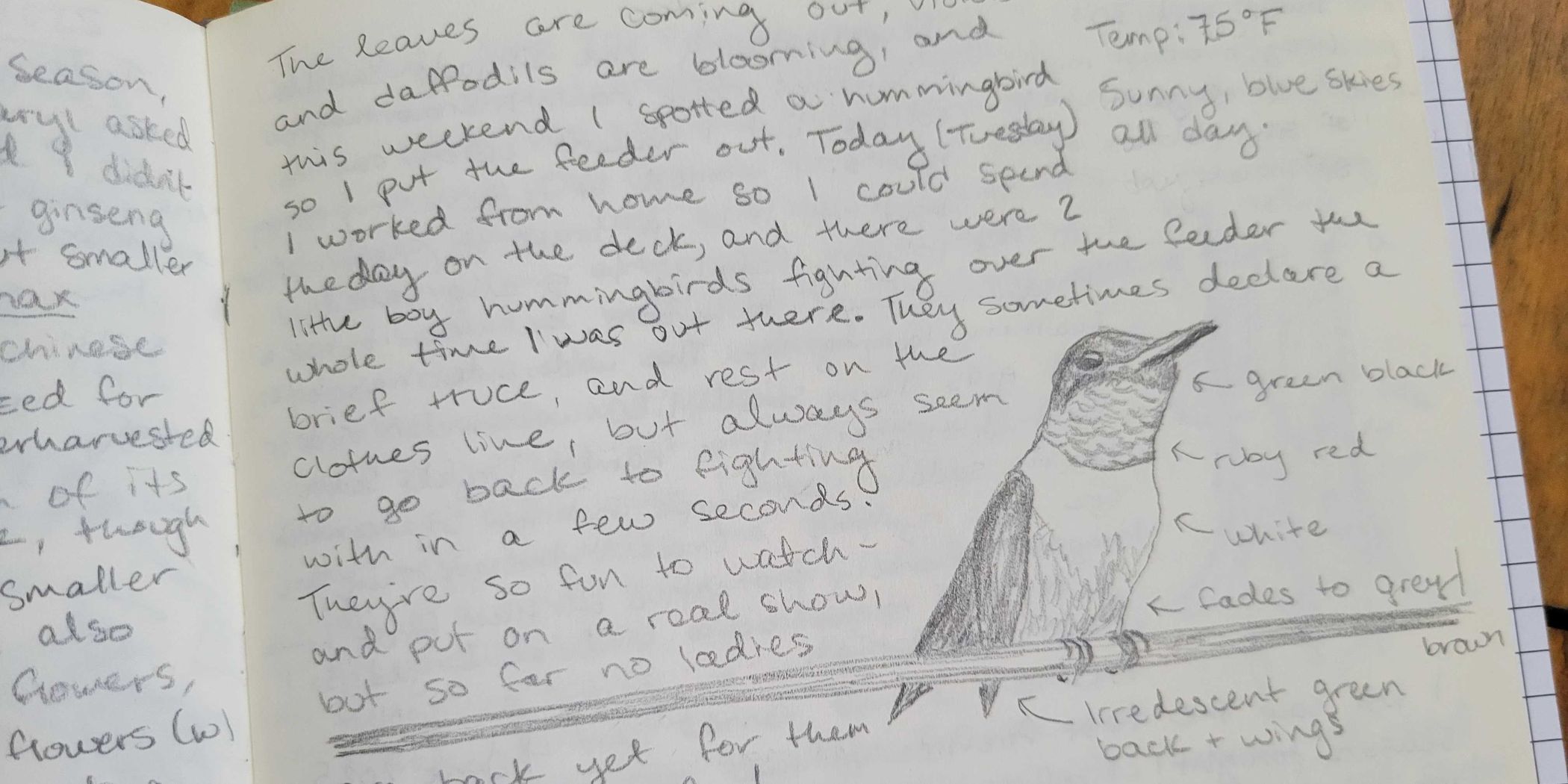
Field Notes by Shelby Perry, Wildlands Ecology Director
“I have kept (at least) nine different Nature journals in my life. They have ranged in format from short notes in calendar squares to detailed pencil drawings and natural history observations in a hardcover bound journal. My favorites are the ones that started with a question, often in the form of a species I didn’t recognize: a random text from a friend with a picture of a bug, a mysterious plant in a crack in the pavement downtown, veins of yellow slime across a leaf in the woods. The ensuing journey through field guides, internet searches, and dichotomous keys usually serves to teach me much more than I originally set out to learn. Capturing that learning quest in my journal means that I can revisit that entry as a future reference (and sometimes even build on it over time), but also that I can reconnect with those feelings of curiosity, inquiry, and discovery that I had at the time of the initial entry.
“I aspire to maintain a daily journal practice, exploring a different focused Nature observation in writing and art every single day, but I am also learning to embrace that I might not—and don’t have to—record an entry every single day. Some days I paint a watercolor, take a photograph, or fill in some details on a calendar square. Some days I just watch and experience Nature without feeling any need to record or collect my observations at all.
“At first I was hard on myself for the big gaps between my journal entries. But then I realized that those gaps don’t impact the value of the entries that are there. When I shift medium or format, or take a break altogether, I never stop benefitting from the learning I did when I was journaling regularly. That learning, for me, is the ultimate purpose of the exercise.”
Tracking Seasonal Patterns with Jason Mazurowski, Wildlands Ecologist
“My favorite thing about studying the natural world is the mind-boggling, eye-opening feeling that comes with uncovering a new ‘layer’ of the story. Imagine you’ve spent your entire life listening to birdsong, but it has existed only as background noise—like the soundtrack to a film. Then one day you add intention to your listening by trying to notice which birds make which sounds, and it’s as if someone has turned up the volume. Suddenly, what was one background noise is now a complex symphony. This simple act of “noticing” has become a daily ritual in my life: part meditation, part observation, part recreation.
“The practice of putting that noticing ‘on paper’ has taken many forms over the years, nearly all of them unconventional. Often, my most interesting observations happen unexpectedly: while scrambling through the backcountry or heading out on a daily run. Characteristically, I’m without a notebook or a high-quality camera, so I’ve always had to adapt and improvise ways to document what I encounter. These improvisations include everything from voice memos to grainy flip-phone photos of animal scat. I’ve tried many times to keep diligent written logs filled with careful notes and illustrations, but over time those journals and drawings would end up scattered across my desk, tucked onto bookshelves, or sealed in boxes never unpacked between moves. Apparently, I lack the discipline and organization of early naturalists like Thoreau, who had little choice but to rely on such meticulous methods.
“Each spring, when my eyes were eager to spot anything colorful, I found myself wondering about the timing of seasonal events: the first mourning cloak butterflies and mining bees, the emergence of spring ephemerals. ‘This seems awfully early for hepatica to bloom,’ I’d think—before marching off to try to remember which notebook held last year’s observations.
“Eventually, it occurred to me to transcribe my notes into a Google Doc. This way, everything lived in one place, and a simple ‘Control-F’ search could surface whatever I was looking for. Over time, that document evolved into something more like a sandbox—a place where I dumped not only natural history observations, but also the creative thoughts they sparked throughout the day. It became a nature journal, a diary, and a repository for loose creativity.
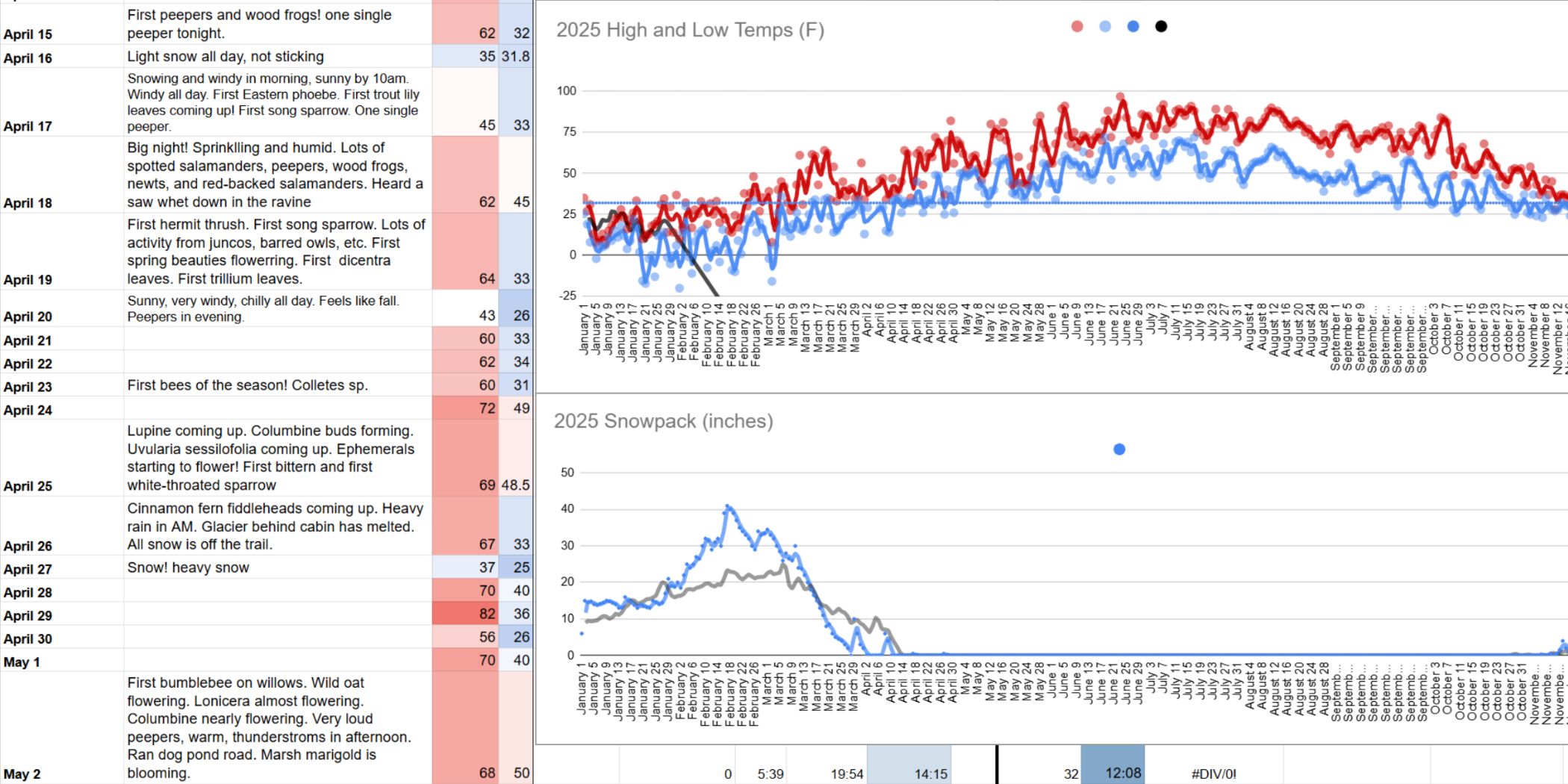
“As I became a landowner tethered to a specific place for a longer stretch of time, I wanted a bit more structure in my daily observations. I began tracking daily temperatures, snowpack depth, and precipitation at my house, allowing me to compare seasonal milestones from year to year. The ‘sandbox’ became a series of annotated spreadsheets that are now quite intelligible. When it feels like ‘the woodcocks have arrived earlier this year,’ I can flip back through my spreadsheets and see exactly when they arrived in previous years—and under what conditions.
“Is this a creative endeavor? I think so, even if it just looks like math. Eventually, patterns emerge, some rather unexpected, spawning new questions I’d never thought to ask. Over years of refining this practice, I’ve discovered that it really doesn’t matter how you journal, or why, but the end result for me has always been a richer, more complex relationship with the natural world.”
Introduction Webinar Recording
Nature Journaling Resources
Visit our events page for more details on Nature Journaling and inspiration photos.
Suggested Books about Journaling:
- Field Notes on Science & Nature by Michael R. Canfield, Edward O. Wilson, George B. Schaller (ISBN 0674057570)
- In season: A Natural History of the New England Year by Nona Bell Estrin and Charles Johnson (ISBN 158465127X)
- The Naturalist’s Notebook: An Observation Guide and 5-Year Calendar-Journal for Tracking Changes in the Natural World around You By Nathaniel Wheelright and Bernd Heinrich (ISBN 1612128890)
- The Beginning Naturalist: Weekly Encounters With the Natural World by Gale Lawrence (ISBN 093305002X)
Citizen Science and Identification Websites and Apps:
- Post observations of living things and a community of naturalists will help narrow down on an ID with the iNaturalist website or app. (https://www.inaturalist.org/)
- Use your camera to get estimated IDs of living things with the Seek App, powered by the data collected through iNaturalist. (https://www.inaturalist.org/pages/seek_app)
- Use the Merlin App on your phone to identify birds by photo, sound, or by answering some simple questions. (https://merlin.allaboutbirds.org/)
- Experienced birders post their bird lists on E-Bird, and you can use the website to filter data and see who birders are paying attention to near you. (https://ebird.org/home)
- The Pl@ntNet app helps you identify plants with photos taken in the field, though it requires internet service to work, so it is not suitable for remote locations. (https://plantnet.org/en/)
Suggested Nature Journaling Websites
- The Wild Wonder Foundation – a non-profit dedicated to nature journaling, they have many of their own prompts, tutorials, classes, and more. https://www.wildwonder.org/
- Marion’s World Phenology Wheel Tutorial – A how to on making a phenology wheel, a different way to record natural change over time. https://www.youtube.com/watch?v=YacViSxyKu8&list=PLOcpU7tS8uYAr_s5bkexynJoe6eour6nl
Week One: Food theme
Prompts:
- Phenology: Note first signs of animals emerging from hibernation
- Study tracks in mud or sticky snow, how many can you identify?
- Look for 3 things animals are eating right now, who is eating them, can you tell?
- Look at aspect and snow pack – where does snow hang on late, where does it melt first?
- Explore the subnivian – can you see where rodents have been traveling under the snow? Where were they going?
- Find a wet spot – who has visited? How does it compare to the ground around it?
- Look for animal sign other than tracks: browse, bark, nests, burrows.
Resources:
- NEWT Wildlands Ecologist Jason Mazurowski’s Phenology Log template in Google Sheets. Make a copy of the sheet to fill in your own information. (File > ‘Make a copy’).
- Use Mass Wildlife’s Tracking Card for tracking information for some of our most common species.
- If you want to get really into tracking, grab yourself a copy of Mammal Tracks and Sign of North America by Mark Elbroch and Casey McFarland (ISBN 0811737748).
- You can find a detailed list of track and sign resources here, compiled by biologist, naturalist, and expert tracker Jonah Evans.
Week Two: Bird Theme
Prompts:
- Get to know a bird
- Note signs of thawing/warming
- Imagine this place three months from now. What will be different?
- Look up — what evidence of wildlife is above eye level?
- 15-minute listen, then open writing
- Write a poem about meltwaters
- Visit the same place twice in one week. What changed? What didn’t?
Resources:
Week Three: Plant Theme
Prompts:
- Look for first flowers; draw or describe them
- Watch for buds expanding on trees and shrubs
- 15 minute sit-spot, then open writing
- Draw the same plant three times this week; look for what changes
- Use the Merlin App to make a morning bird list
- Write about the weather
- Journal about what spring things you’re looking forward to
Resources:
- The book Trees Up Close by Nancy Ross Hugo and Robert Llewellyn (ISBN: 160469582X) has excellent photos of tree flowers. Check your local library for a copy or find it at a local bookstore.
- This Northern Woodlands article explains why spring ephemerals are so rare in New England.
- Here is a blog post with a detailed how-to for forcing tree flowers indoors. Though she describes ornamentals, the process is the same for any tree. Personally, I prefer to cut from already broken or fallen branches, but you can also cut straight from the living tree, particularly if your apple tree needs pruning.
Week Four: Insect Theme
Prompts:
- Look for early pollinators.
- Find the first spring ephemeral wildflowers.
- Write a haiku about rain.
- Note the first frog calls you hear.
- Find and describe a germinating seed.
- Choose one spot you can return to this month. Give it a name.
- Describe your spot without naming any species.
Resources:
- Vermont Center for Ecostudies’ early season pollinator guide
- U.S. Phenology Network – Track major phenological events and contribute to citizen science
- A couple of articles about overwintering insects from Northern Woodlands magazine:
- A poem we think you’ll enjoy by NEWT friend and naturalist Bryan Pfeiffer
Sold Out – 2026 Guided Spring Nature Journaling Series Schedule and Introduction recording
Zoom webinar, followed by emailed prompts | March 19 – April 17, 2026
Northeast Wilderness Trust’s Spring 2026 Guided Nature Journaling program kicked off on Thursday, March 19, 2026 with the Zoom webinar “Introduction to Nature Journaling with NEWT.” The webinar will be followed by weekly Friday email prompts and encouragement to share journaling photos with NEWT’s Wildlands Ecology team. The program will conclude with a Zoom meet-up on Friday, April 17, where participants will have the opportunity to share their favorite journal entries, reflect on the journaling process, and celebrate the natural world together.
Series schedule:
Thursday, March 19 | Webinar: “Introduction to Nature Journaling Webinar with NEWT,” guided by Wildlands Ecology Director Shelby Perry – recording above.
Friday, March 20 | Email with instructions and journaling prompts
Friday, March 27 | Email with inspirational photos and journaling prompts
Friday, April 3 | Email with inspirational photos and journaling prompts
Friday, April 17, time TBA | Closing celebration via Zoom
Registration for this series is closed.
Materials needed:
- Sketchbook, notebook, or other medium of choice
- Pencil, pens, or drawing/writing tool of choice
*By signing up for the program, registrants give Northeast Wilderness Trust permission to use photo submissions on Northeast Wilderness Trust’s website and social media channels. You will also be signed up for the NEWT monthly enewsletter. If you would like to opt out, please contact events@newildernesstrust.org.