At Home at Woodbury Mountain Wilderness Preserve
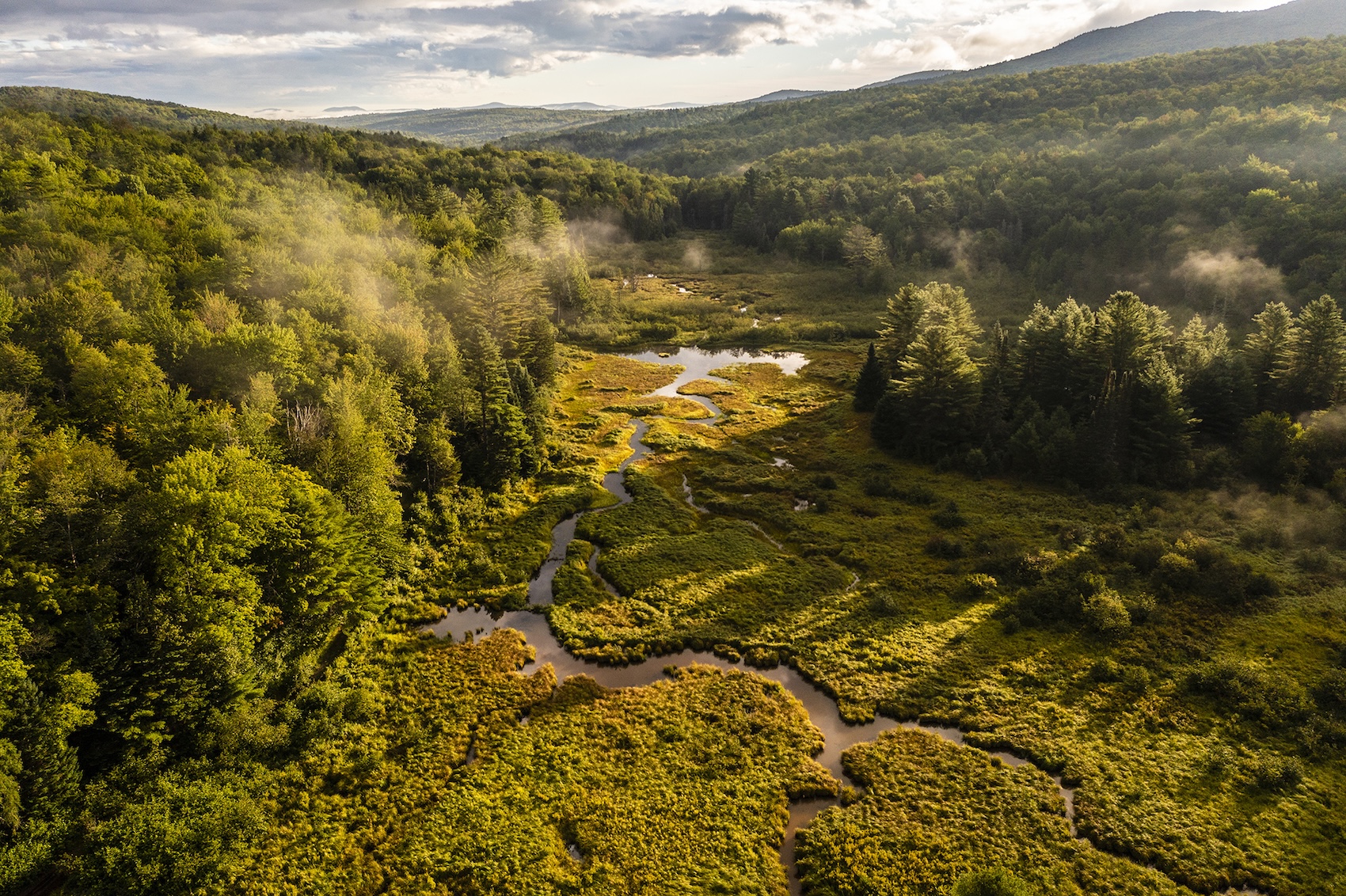
Four years ago, I moved into a little log cabin in a cold hollow at the edge of Vermont’s Northern Green Mountains. Tucked into a narrow valley where creeks, ponds, and slow-flowing fens meander through spruces and tamaracks, the place already felt wild and remote compared to the bustling city of Burlington, where I had attended graduate school. The cabin was surrounded by forest and overlooked a tangled, impenetrable alder swamp. From what I had gathered from the realtor, the neighboring lands were owned by a timber company, and not much was known about whether they would be logged again in the future—though my ears perked up as he casually mentioned some recently conserved land on nearby Woodbury Mountain.
A couple weeks after moving in, I heard something crash through the hobblebush across the road and saw a woman emerge from the woods carrying a hammer and signs that read, “CONSERVATION AREA BOUNDARY.” She turned out to be Northeast Wilderness Trust’s (NEWT) Vermont Land Steward, who shook my hand enthusiastically and explained that we were now neighbors: NEWT had just protected the 123-acre parcel, dubbed “The Spring Addition,” abutting my land. The Spring Addition, she told me, expanded the organization’s ~6,000-acre Woodbury Mountain Wilderness Preserve. She informed me that my home was now surrounded on three sides by the largest non-governmental wilderness in Vermont. It was my first formal introduction to Northeast Wilderness Trust.
At the time, I was an independent ecologist, and I immediately offered to help however I could. Every now and then I would volunteer to hang signs, help remove trammels, and lead Nature walks. A couple of years later, I saw a NEWT job posting for a full-time Wildlands Ecologist that would change the trajectory of my career. But long before studying wildlands at the organization became my job, the Spring Addition’s rewilding woods and wetlands had become part of my daily life. For the past four years, I have had the unusual privilege of watching a recently protected forest begin to mature, according to the ebb and flow of Nature rather than human intervention, from my doorstep.
On the timescale of a forest, four years is barely a blink of an eye. One might assume that little would change in such a short period. But I know now that forests are dynamic, living things, as alive as the individual species that make them. While tree growth that proceeds by just millimeters or centimeters in diameter a year may seem like a slow process, some of the more profound changes experienced by a forest can happen over days or weeks.
Perhaps the most dramatic change I have witnessed in these four years was the creation of a new beaver pond on the Addition, which I documented in a previous blog post. Within days of the industrious rodents constructing a dam in a nearby alder swamp, the swamp flooded and a pond formed. I have since watched new generations of beavers grow up on the pond and a host of plants and animals move into the newly established habitat. The pond now supports a thriving population of brook trout, sought now by bald eagles, herons, kingfishers, and more. I’ve seen young moose wading in the shallows, stripping willow buds, and I’ve watched bears, bobcats, and foxes traverse the dam to cross the pond.
Then there are the changes that happen in an instant. I bear witness to falling trees more often than one might think. Sometimes I hear the crash of a birch succumbing to the teeth of a beaver in the middle of the night. Other times I witness a massive pine uprooted by an intense summer squall. And still other times, seemingly for no reason at all, a maple meets the forest floor on a calm, clear day—perhaps its lignin, the organic substance key to plant structure, weakened by fungi until it has simply reached a tipping point.