A Fondness for Salamander Eggs
I was climbing a steep logging road on a late spring morning when I came upon a puddle. There was nothing particularly notable about it, nor about the surrounding forest, which featured neither the mossy complexity of an old forest nor the tangled, prickly chaos of a recent timber harvest. Lying in a shallow depression in the tread of a former skid trail, now rewilding, the puddle’s waters were murky from recent rains. By all accounts, it was an ordinary puddle in an ordinary, middle-aged northern hardwood forest.
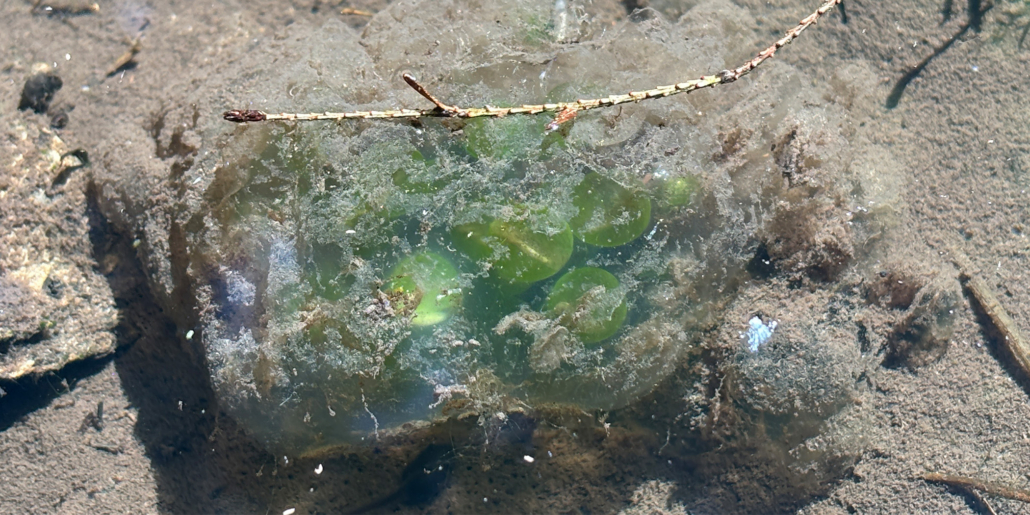
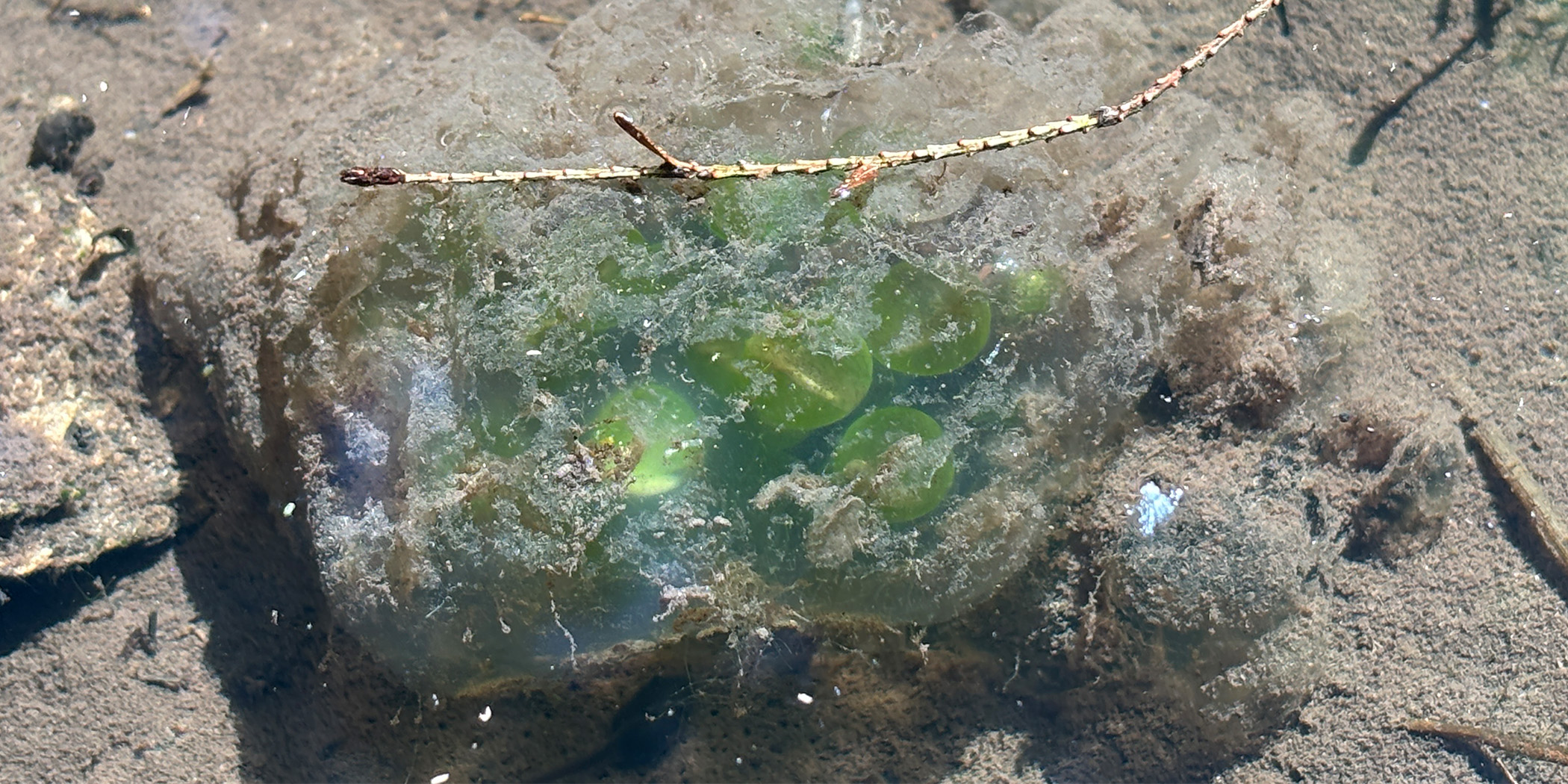
But as field naturalists are prone to do, I stopped anyway. Notebook in hand, I jotted down a few of the puddle’s dimensions while swatting away mosquitoes. I was looking for evidence of amphibian breeding—a diagnostic feature for determining whether this was a bona fide vernal pool or merely a glorified mud puddle. A barred owl feather floated on the surface, wood frog tadpoles darted among the detritus, mosquito larvae wriggled about, and near the edge of the puddle, attached to a small stick, was a cluster of eggs coated in green slime.
Upon closer inspection, I realized that the green slime wasn’t merely coating the egg mass—it was growing within the mass, in the gelatinous material in which the eggs sit. Standing in ankle-deep muck beside an old Adirondack logging road, I was looking at one of the strangest partnerships in the natural world.
Strange—but Symbiotic—Bedfellows
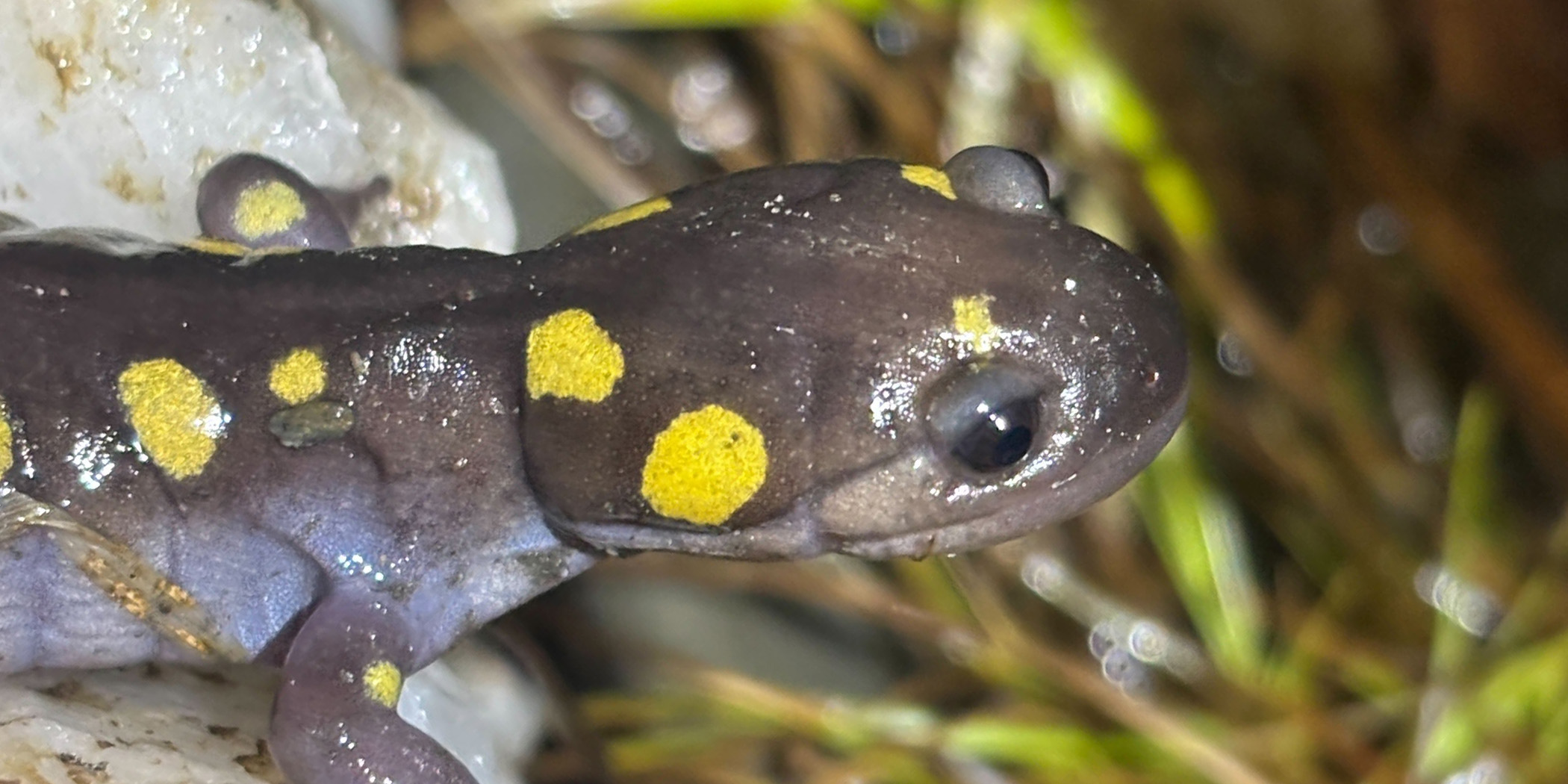
The eggs belonged to the spotted salamander (Ambystoma maculatum), and the mass’s green hue came from an alga (the singular form of “algae”) called Oophila amblystomatis, a name that translates fittingly to “lover of salamander eggs” or “a fondness for salamander eggs.”
The spotted salamander is a mysterious creature in its own right. For nearly the entire year, the species remains hidden beneath the forest floor, emerging only once during the first warm rains of spring to migrate by the thousands to nearby vernal pools. There, females deposit in the water gelatinous masses containing dozens to hundreds of fertilized eggs, identical to the one I had found, before returning below ground for the next 364 days. As the embryos develop through the spring, the “lover of salamander eggs” algae proliferate within the egg masses, turning their hosts a distinctive shade of green.
This association between algae and spotted salamander eggs has likely been observed for as long as humans have been peering into vernal pools, but the true extent of the relationship did not come into focus until quite recently. In 2011, researchers discovered that the algae were not merely growing within the egg masses’ gelatinous material—they were growing within the future salamanders themselves! It was the first known example of a photosynthesizing microorganism infiltrating a vertebrate’s actual cells.
The finding challenged long-held assumptions about the limits of symbiosis between life’s kingdoms. “Photosymbiosis,” whereby a photosynthesizing microorganism lives within a host, is a well-documented form of symbiosis, but usually involves and benefits a host that cannot produce or acquire its own food (also known as a “heterotroph”). Since spotted salamanders have no trouble finding their own food, they are not heterotrophs, making the relationship I witnessed all the more remarkable. (While not entirely accurate, the relationship is often referred to as the only known example of an animal “photosynthesizing,” though the algae are the ones doing the photosynthesizing.)
A Mutually Beneficial Partnership
Like most of nature’s enduring partnerships, both participants appear to gain something from the arrangement. The algae help oxygenate the egg mass and simultaneously absorb waste products, while the salamander embryos provide nutrients and carbon dioxide that fuel algal growth. It may seem like a fairly modest advantage, but when considering that only 1 in 200 eggs reaches the larval stage and only a small fraction of those larvae ever reach adulthood, even marginal benefits may be enough to tip the scales for natural selection to preserve the partnership.
This relationship is hardly the only oddity lurking in our wetlands: Wood frogs survive winter by freezing solid—their hearts stop until spring. Gray treefrogs, we now know, may actually be two nearly identical species, one carrying twice the number of chromosomes as the other. Mole salamanders have developed hybrid lineages that challenge our understanding of speciation. These are all evolutionary experiments still unfolding in the wet corners of our woods, in countless pools and puddles scattered across the Northeast.
And these fascinating puzzles are just a few of those among vertebrates, which make up only a tiny fraction of life’s diversity. The vast majority of organisms are small, inconspicuous, and poorly understood. Entire chapters of many of their natural histories remain unwritten, hidden in plain sight. Nature’s greatest mysteries are not always found in remote jungles or the old-growth cathedrals of temperate rainforests; sometimes the most remarkable stories unfold in the most ordinary places.
If such a relationship could remain overlooked for so long in one of the Northeast’s well-known amphibians, it raises an obvious question: What other evolutionary wonders have yet to be discovered throughout our rolling, rewilding landscape?