Tag Archive for: Event

Towards Coexistence with Large Predators

Northeast Wilderness Trust’s (NEWT) conservation work is guided by a trio of principles: cores, corridors, and carnivores. These, referred to as the “3Cs,” inform NEWT’s decision-making when prioritizing potential land projects in pursuit of an ecologically connected and vibrant Northeast.

The third of these principles, carnivores, refers to the presence on wildlands of large predator species. These species exert downward pressure on the web of life that makes up ecosystems, helping to keep them balanced. But human domination of the landscape, as well as outright extermination campaigns of these species in some instances, has led to the decimation of these vital ecosystem engineers and their disappearance from wide swathes of their original ranges, with far-ranging consequences for ecological health and resilience.

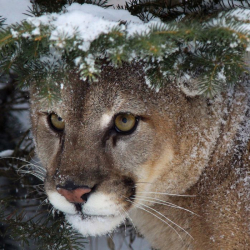
In the Northeast, the two primary predator species now mostly absent from the landscape are wolves and mountain lions. The latter of these was the focus of NEWT’s recent Speaker Series webinar, “The Role of Large Carnivores in Rewilding Ecosystems.” Dr. Mark Elbroch of Panthera, the global wildcat conservation organization, joined NEWT’s Wildlands Ecology Director Shelby Perry for a conversation about mountain lions (or catamounts, or cougars, or pumas, or any of the “more than 250 names documented across the Americas” for this species, according to Elbroch) and the ecosystem role of large predators.
Perspectives on Rewilding, from the Northeast to the Great Plains

Herds of mammoth. Saber-tooth tigers lurking in the tall grasses. American cheetahs—yes, you read that correctly—speeding after pronghorns.

Thousands of years ago, this was the scene on the Great Plains—current day Colorado and surrounding states. Tall- and shortgrass prairie predominated across a wide swathe of the lower 48 states, maintained by grazing bison and natural fires that kept woody encroachment by shrubs and trees at bay. This was a rich, biodiverse expanse that, in its labyrinthian root systems in the soil, sequestered vast quantities of carbon. In the words of Henry Pollock, the executive director of Southern Plains Land Trust (SPLT) and the kickoff speaker in Northeast Wilderness Trust’s (NEWT) 2025 Speaker Series, the prairie was “a veritable American Serengeti.” Pollock and NEWT President and CEO Jon Leibowitz discussed the differing challenges and opportunities in rewilding the Great Plains and NEWT’s service region, the Northeast. Check out the full recording of the webinar below.

At the same point in geological time that mammoths, tigers, and cheetahs prowled the Plains, old forests sprawled across what is now New England a thousand or more miles east. Hurricanes, ice storms, and other forms of natural disturbance blew through every so often, felling trees, opening up canopy gaps, and creating structural complexity. In these great forested wildlands, wolves and cougars hunted deer and other ungulates. Streams and rivers shaded by hemlocks teemed with brook trout and Atlantic salmon. Massive flocks of passenger pigeons darkened the skies.  Caribou walked across parts of the landscape and harbor seals called Lake Champlain home.

Northeast Wilderness Trust hosts third Learning Circle Book Group

Sign up to join Northeast Wilderness Trust’s third Learning Circle book group. We will discuss The Overstory by Richard Powers, which won the Pulitzer Prize for Fiction in 2019. The novel follows nine people as their lives become entwined in the fight to save old-growth forests.

The novel integrates recent learning about trees and old-growth forests and highlights NEWT’s belief that We are One of Many.

The Learning Circle book group will meet via Zoom on three Wednesdays, January 29, February 19, and March 12, from 7:30 pm to 8:30 pm EDT. Three sessions will allow participants to get to know each other and to divide the reading and discussion into three parts. The January 29 session will cover the first 150 pages of The Overstory.

If you are interested in participating, please register below by December 31, 2024. Details on the sessions and Zoom link will be emailed to registered participants in early January 2025. You may participate even if you can only attend two of the three sessions. David Hindin, a NEWT supporter who facilitated the first two Learning Circle book groups, will again be our facilitator.

We look forward to meeting you!

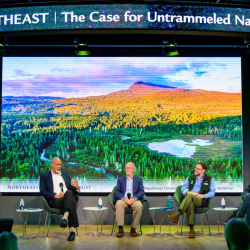
NEWT and Partners Convene in Boston to Make the Case for Rewilding

“How do we create a more habitable world for our children, for our grandchildren, and for all the species with whom we share this beautiful planet” at a time of climate change and an accelerating extinction crisis? This was the central question posed by Kelsey Wirth, Founder of Mothers Out Front, at a panel and reception event convened by Northeast Wilderness Trust (NEWT) last month.

There is, of course, no single solution to these multidimensional challenges, but NEWT leaders and key partners shared the power and promise of forever-wild land conservation with a sold-out audience at WBUR CitySpace in Boston, Massachusetts.

NEWT President and CEO Jon Leibowitz argued that to preserve the Northeast’s natural heritage and the wellbeing of future human and nonhuman generations, we should intentionally create room for Nature to do what it did on its own for millions of years before human intervention: evolve freely, with forests growing old, fostering biodiversity, and storing massive amounts of carbon.

This may sound like a straightforward proposal, but in Leibowitz’s words, rewilding is an “incredibly underutilized” conservation tool. Though New England is more than 80-percent forested, just 3.3 percent of these forests are protected in perpetuity as wildlands, where Nature calls the shots. Increasing this number by creating more wilderness preserves means “to work with Nature, rather than against it,” Leibowitz added. Rewilding “restores ecosystems not through control or manipulation, but by trusting in Nature’s innate resilience and proven ability to find stability.”

The Wild Times: June

NEWT named “Conservationist of the Year” plus our newest land acquisition, wildlife photos from our stewards, and more June updates.

The Wild Times: May

Land protection highlights and other updates from the Wilderness Trust.

Northeast Wilderness Trust hosts second Learning Circle book group

Sign up to join Northeast Wilderness Trust’s second Learning Circle book group. 

Woodbury Mountain BioBlitz

Become a nature detective and a citizen scientist by participating in the Woodbury Mountain BioBlitz from August 2023 through July 2024.

The Wild Times: January and February

With an additional 6,354 acres protected in 2023, last year was wildly successful for wilderness recovery, thanks to you. Places like Moriah Wilderness Preserve in New York and Sargent Hill Wilderness Preserve in Vermont, both protected last year, have begun their rewilding journey.

Northeast Wilderness Trust hosts first Learning Circle book group

Northeast Wilderness Trust is launching our first Learning Circle book group in January 2024.

Woodbury Mountain BioBlitz: September Events

Get curious about turtles, amphibians, and late season pollinators with Northeast Wilderness Trust at two events on the land this fall.