Tag Archive for: Massachusetts

230-Acre River’s Edge Wilderness Preserve Established in Massachusetts

A version of this press release first appeared in the Daily Hampshire Gazette on August 1, 2026 as “Worthington, Huntington land conservation adds more than 700 acres.”

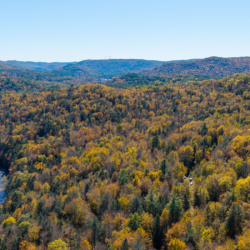
MONTPELIER, VERMONT—Northeast Wilderness Trust, a regional land trust focused on wilderness conservation, announced today that 230 acres of forestland and 6,100 feet of Westfield River frontage in Huntington have been permanently protected as “forever-wild.” The project, called River’s Edge Wilderness Preserve, advances Massachusetts’ ambitious climate and biodiversity goals. The Wilderness Trust received more than $400,000 in grant funding from the Healey-Driscoll Administration’s Acquisition for Forest Reserves Grant Program to support acquisition of the property, which will be passively managed to maximize its benefits to wildlife and to put down the roots of a future old-growth forest.

“River’s Edge Wilderness Preserve demonstrates the power of conservation to connect habitats and reduce fragmentation of critical landscapes,” said Massachusetts Energy and Environmental Affairs Secretary Rebecca Tepper. “Northeast Wilderness Trust’s work aligns with our mission of protecting Massachusetts’ rich biodiversity found within aquatic and land habitats, and we’re proud to support the connection of 230 acres to over 1,500 acres of state and federally protected lands.”

Under the Healey-Driscoll Administration, Massachusetts has distinguished itself as a national leader in forward-looking land conservation policy—serving the needs of both people and Nature. The state’s “Biodiversity Goals for Massachusetts,” as well as its recent decision to join the International Union for Conservation of Nature (IUCN), are encouraging steps toward a wilder, more sustainable future for the Commonwealth. So too are the $425,000 award to River’s Edge from the state’s Executive Office of Energy and Environmental Affairs, as well as a $310,000 grant from Mass Audubon’s Catalyst Fund.

“Helping Northeast Wilderness Trust permanently protect this biodiverse and carbon-rich land is exactly why we started our 30×30 Catalyst Fund, which provides critical financial and technical support to our conservation partners,” said David O’Neill, President and CEO of Mass Audubon. “This is how Mass Audubon has tripled the pace of land conservation and is a perfect example of how much we can achieve when the conservation community comes together to meet the state’s land conservation targets.”

The award demonstrates that both public agencies and nonprofit groups recognize the crucial role private conservation has to play in meeting the state’s lofty goals. About 65 percent of Massachusetts’ forestland lies in private hands. Of these landowners, land trusts, with their community connections and technical know-how, are well positioned to help cement Massachusetts’ biodiversity and climate leadership.

Especially powerful is when land trusts join forces, as exemplified by River’s Edge: Northeast Wilderness Trust partnered with Kestrel Land Trust, a fixture of land conservation in the Connecticut River Valley and beyond, to execute this project. Northeast Wilderness Trust now owns the 230 acres of River’s Edge outright, and Kestrel Land Trust will hold a conservation restriction on the property, securing a durable, forever-wild outcome for the Preserve.

River’s Edge Wilderness Preserve is significant not just for the acreage protected, but for how that acreage will be managed—or not. The Preserve, like all of Northeast Wilderness Trust’s properties, is now a “wildland,” a place where logging will forever be prohibited, human management will be minimal, and the forest will evolve and grow freely. This passive management strategy—often referred to as “rewilding”—is similar to the approach used on lands designated by Massachusetts as “forest reserves.” The establishment of River’s Edge, then, represents tangible progress toward the Healey-Driscoll Administration’s “Forests as Climate Solutions” targets. This visionary initiative calls for the tripling of the amount of Massachusetts’ forests, inclusive of both publicly and privately owned ones, protected as “forest reserves.”

Wildlands such as these harbor greater species diversity and sequester more carbon than managed forests, and yet just 2.3 percent of Massachusetts is protected as such. River’s Edge pushes the state closer toward its goal of 10 percent of forestland safeguarded as forest reserves.

“Wildlands are a crucial but underrepresented part of Massachusetts’ storied conservation landscape,” said Jon Leibowitz, President and CEO of Northeast Wilderness Trust. “Along with their outsized contributions to climate stabilization and human wellbeing, these special places act as bastions of biodiversity, where wildlife can find respite from human pressures like habitat fragmentation. With forever-wild protection, River’s Edge Wilderness Preserve will naturally evolve into an old-growth forest and provide a permanent home for the plants and animals with which we share this landscape. It’s a win for the Bay State’s natural heritage and a boost to its ambitious biodiversity and climate goals.”

About Northeast Wilderness Trust: Northeast Wilderness Trust, a Montpelier, Vermont-based regional land trust, conserves forever-wild landscapes for Nature and people. It accomplishes this work by acquiring and stewarding land as forever-wild, and by holding forever-wild conservation easements on properties owned by other organizations or individuals. Across New England and New York, the Wilderness Trust secures wild places where Nature can thrive, wildlife can wander, and people can find beauty and quiet. Since its founding in 2002, Northeast Wilderness Trust has protected more than 116,000 acres, of which more than 550 are in Massachusetts. Learn more at www.newildernesstrust.org.
Rate That Snag!

A frequent sight on Northeast Wilderness Trust’s (NEWT) forever-wild preserves and easements is coarse woody debris (CWD). CWD is the wood that accumulates in forests as trees and shrubs die. Tree mortality is a natural part of forest ecosystems, and the resulting CWD is a crucial ecological element that provides homes for insects, birds, and mammals and recycles nutrients back into forest soils.

One of the most recognizable forms of CWD is standing dead trees, also called “snags.” Managed timberlands often lack snags because logging operations prioritize tidy, navigable landscapes. But on NEWT properties, they are a common and welcome feature of “messy” old forests that support greater species diversity and sequester more carbon.

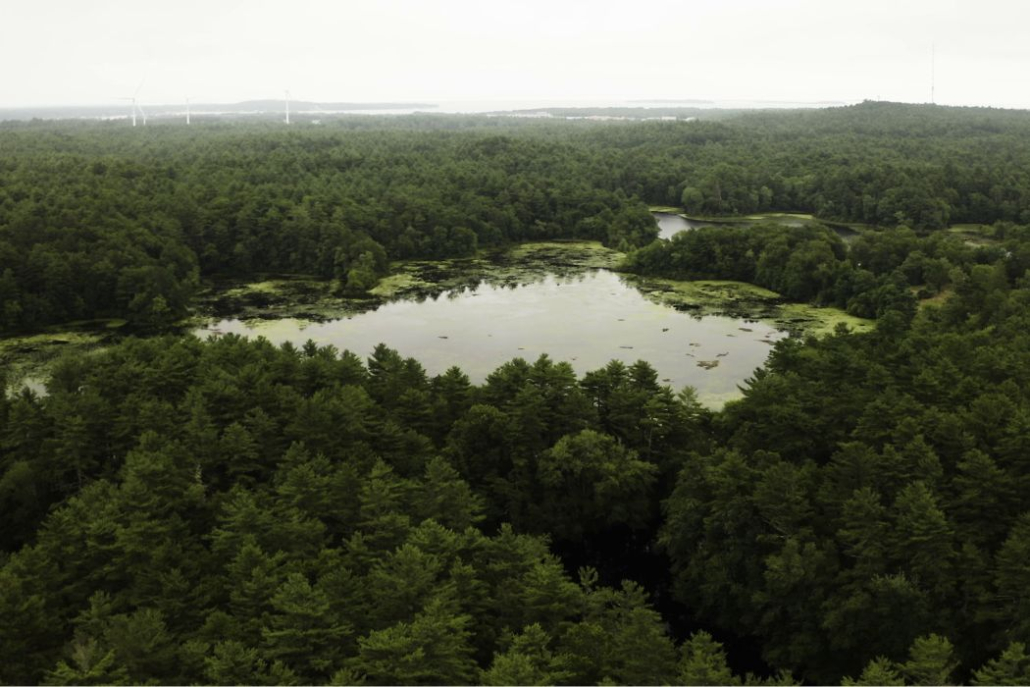
The forests at NEWT’s Muddy Pond Wilderness Preserve in southeastern Massachusetts are no exception. Since coming under forever-wild protection in 2018, Muddy Pond’s 322 acres in Kingston have been on the march toward old growth. Part of that rewilding process involves the death of old or weakened trees, which remain standing at Muddy Pond to continue contributing, as they did in life, to the Preserve’s ecology.

Changing the Conversation

Among the hundreds of species of birds, mammals, reptiles, insects, and amphibians that call them home, Muddy Pond’s snags also have a two-legged admirer: NEWT’s Southern New England Land Steward Joe Falconeiri.

You might call Falconeiri a dead-wood devotee. When hosting groups of students or volunteers at the Preserve, or giving talks in the wider area about wildlands stewardship, Falconeiri always sings the praises of CWD as a vital but overlooked—and misunderstood—feature of healthy forest ecosystems. He finds that for most people, from high-school students to arborists, dead trees are eyesores or risks. And while he acknowledges that dead trees in suburban settings can become hazardous depending on their surroundings and proximity to humans and human-made structures, he contends that this obscures their ecosystem role. A group of dead and dying trees at his home in Massachusetts, for example, hosts nesting Northern Flickers, a woodpecker species.

“Snags are anything but ‘hazardous’ when looking at them from an ecological perspective,” Falconeiri said. “Within the forest, they are the opposite of hazardous. Public safety is an important part of the conversation in suburban environments, but we need to define what ‘hazardous’ really means. This is why wilderness education in our communities and region is so critical.”

Part of that education involves encouraging people and communities to rethink their view of dead trees as blemishes on the landscape. If we learn to admire snags in the same way we admire a towering hemlock or a majestic oak, might we in turn become more comfortable with CWD and the other aspects of unmanaged forests that promote biodiversity and greater carbon storage?

To that end, Falconeiri has photographed some of the most eye-catching dead trees at Muddy Pond. Check out the photos below and their captions to see how this snag specialist ranks his favorite specimens.

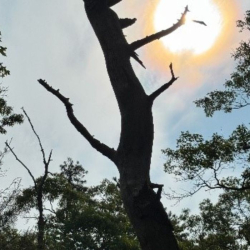
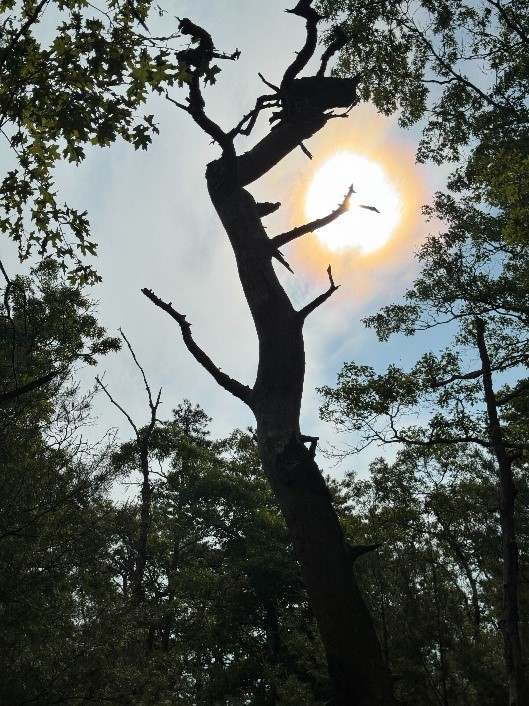
Silhouette of dead tree against the sun

Joe’s Rating: 10/10

“This beauty stands out in the middle of the forest on a high point. With a few large woodpecker cavities visible, and a smooth, monotone, barkless veneer, it is the perfect perch for local owls, hawks, and Muddy Pond’s visiting Bald Eagle.”


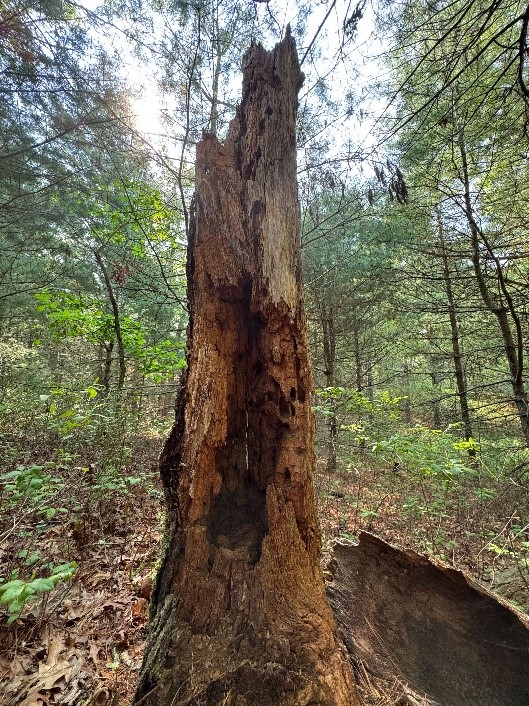
dead tree in the middle of the woods

Joe’s Rating: 8.2/10

“This short and stout coniferous snag showed lots of insect and carpenter ant activity. It would be a perfect dinner or snack spot for the local Prairie Warbler or Downy Woodpecker, or even a forage opportunity for a fox.”


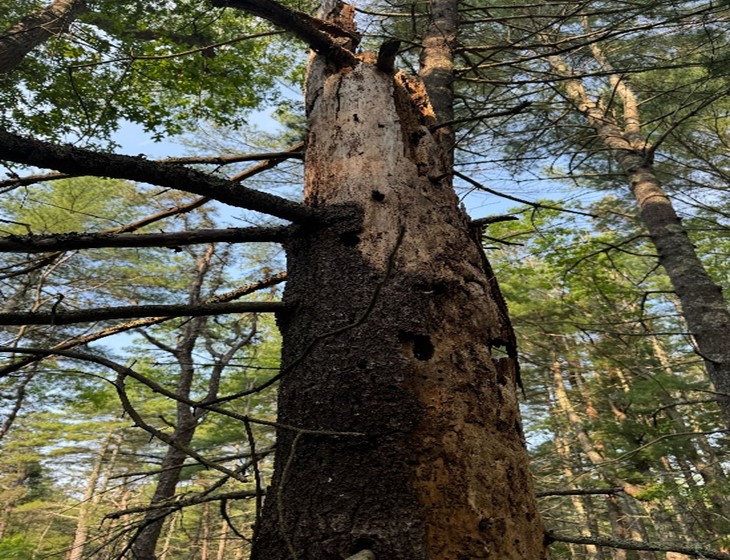
View of dead tree and the canopy above

Joe’s Rating: 8.4/10

“Old eastern white pine with multiple cavities showing the grand beauty of standing decomposition and decay. This grandiose testament to Nature’s cycles rises out of the black huckleberry understory below. Will we listen to the life lessons it offers?”


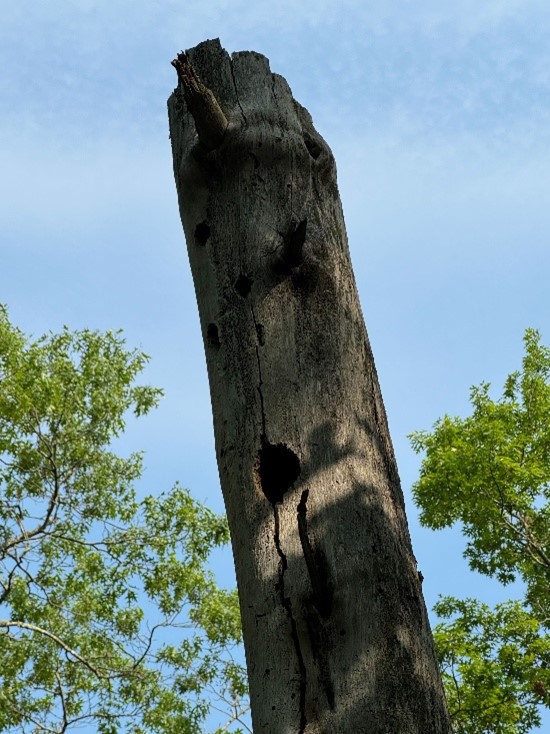
End of a dead tree jutting into the sky

Joe’s Rating: 7.5/10

“Major cavity sitting high in old oak tree deep in the forest. Stable and sturdy hardwood snags not only make a nice nesting spot for woodpecker species; they can be welcome homes to secondary cavity nesters such as raccoons and owls.”


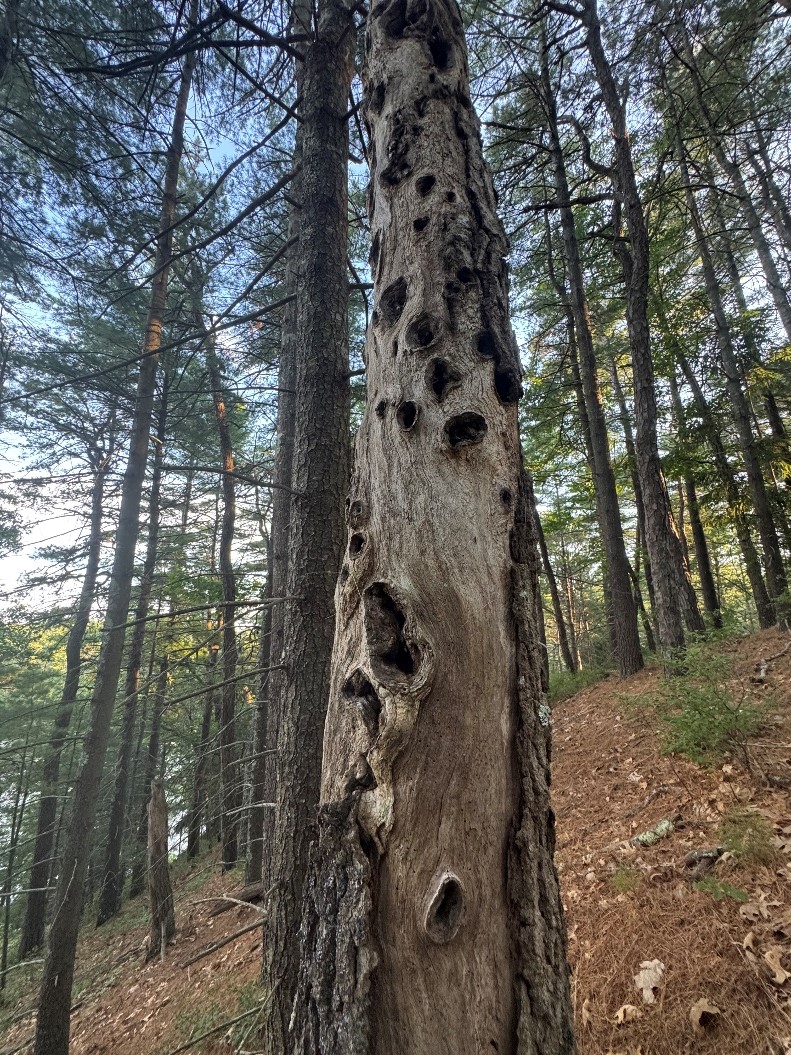
Dead tree with cavities from woodpeckers

Joe’s Rating: 9/10.

“Multiple woodpecker cavities and a partially hollow trunk equal great potential for biodiversity. The cavities offer real estate for secondary nesters such as Black-capped Chickadees, Tufted Titmice, squirrels, and owls. My good ol’ friend the Blue Jay and others may also use the cavities for food storage.”

NEWT and Native Land Conservancy Partner to Protect Wampanoag Lands

This story first appeared in the Cape Cod Times on November 18, 2024.

KINGSTON, MA—With a recent gift of 33 acres of land in Kingston from a regional land trust, Native Land Conservancy in Mashpee now holds almost 100 acres across seven Massachusetts towns.

Prior to this gift, the Conservancy held titles to about 65 acres in Mashpee, Yarmouthport, Easton, Barnstable, New Salem, and Aquinnah.

“This donation from Northeast Wilderness Trust serves to deepen our relationship as neighbors,” said Conservancy Founding President Ramona Peters, a member of the Mashpee Wampanoag Tribe. “And gives us the opportunity to care for these lands in our fullest capacity as Indigenous land protectors.”

The 322-acre Muddy Pond Wilderness Preserve, owned by Northeast Wilderness Trust, that abuts the 33 acres of land recently gifted to Native Land Conservancy.

The 33 acres joins with the Conservancy’s 32-acre Wampanoag Common Lands at Muddy Pond in Kingston and the abutting 322-acre Muddy Pond Wilderness Preserve, owned by the trust, also in Kingston.

“Working together with the Native Land Conservancy has been an enriching experience for Northeast Wilderness Trust,” said Jon Leibowitz, the trust president and CEO. “Our partnership with NLC has secured habitat and freedom for the wild creatures who call these places home.” The trust is based in Vermont.

The newly donated lands represent a portion of the Wampanoag’s ancestral homelands, according to the Conservancy. The land is also part of the rare Atlantic Coastal Pine Barrens and habitat for four-legged, winged, and finned creatures including garter snakes, bats, coyotes, red-tailed hawks, and wood frogs.

What will the Conservancy do with the land?

The Conservancy plans to permanently conserve the 33 acres, according to a press release.

Alongside the donation, the trust is also conveying a forever-wild conservation easement, which is pending approval from the commonwealth. The easement would be located on the trust’s Muddy Pond Wilderness Preserve.

In reciprocation, the Conservancy will convey a forever-wild conservation easement on the lands gifted by the Trust.

A conservation easement, according to the National Conservation Easement Database, is a legal agreement between a landowner and a conservation organization or government agency that limits how a property can be developed. A conservation easement can protect the land’s conservation values, such as the quality of water or the preservation of forests and agricultural lands.

Conservancy holds land in areas across the state

Among its purchases, in 2023, the Conservancy bought the Aquinnah Shop Restaurant and surrounding land on Martha’s Vineyard for $2 million, with plans to return the land in perpetuity to the Wampanoag Tribe of Gay Head (Aquinnah).

NEWT and Partners Convene in Boston to Make the Case for Rewilding

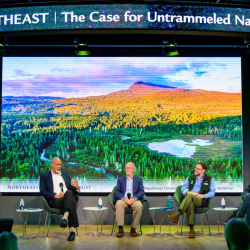
“How do we create a more habitable world for our children, for our grandchildren, and for all the species with whom we share this beautiful planet” at a time of climate change and an accelerating extinction crisis? This was the central question posed by Kelsey Wirth, Founder of Mothers Out Front, at a panel and reception event convened by Northeast Wilderness Trust (NEWT) last month.

There is, of course, no single solution to these multidimensional challenges, but NEWT leaders and key partners shared the power and promise of forever-wild land conservation with a sold-out audience at WBUR CitySpace in Boston, Massachusetts.

NEWT President and CEO Jon Leibowitz argued that to preserve the Northeast’s natural heritage and the wellbeing of future human and nonhuman generations, we should intentionally create room for Nature to do what it did on its own for millions of years before human intervention: evolve freely, with forests growing old, fostering biodiversity, and storing massive amounts of carbon.

This may sound like a straightforward proposal, but in Leibowitz’s words, rewilding is an “incredibly underutilized” conservation tool. Though New England is more than 80-percent forested, just 3.3 percent of these forests are protected in perpetuity as wildlands, where Nature calls the shots. Increasing this number by creating more wilderness preserves means “to work with Nature, rather than against it,” Leibowitz added. Rewilding “restores ecosystems not through control or manipulation, but by trusting in Nature’s innate resilience and proven ability to find stability.”

Rare Plants Thrive on the Rewilding Shores of Muddy Pond

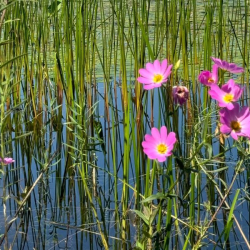
The Plymouth rose gentian (Sabatia kennedyana) shines like a pink sun when it blooms. This rare species occurs on shorelines and in wetlands from southern Rhode Island to the north shore of Massachusetts. The gentian’s limited range and sensitivity to changes in water level and quality, as well as the destruction of wetlands along the Atlantic Coast, threaten the species: in Rhode Island it is endangered, and in Massachusetts it is classified as uncommon and of special conservation concern.

Business Alliance Spotlight: NatureCulture

NEWT’s Business Alliance welcomes NatureCulture, a small Massachusetts-based business working at the intersection of the arts, environmental, and social justice.

New Poem Inspired by Muddy Pond Wilderness Preserve

Written by Kathleen Kremins, “Syncopations” explores the sounds and sights of Muddy Pond Wilderness Preserve through luscious, sensitive verse.

Wildlands in New England: Webinar

Register for the May 31 webinar to learn about the Wildlands in New England report, the first study of its kind to map and characterize all forever-wild lands in the Northeast.

25,000 Wild Acres Protected by 2025…Complete!

Northeast Wilderness Trust is thrilled to announce that we have met our land protection acreage goal for 2025…three years early!

Understanding the Wildlife of Muddy Pond

Get to know the wildlife who reside at Muddy Pond Wilderness Preserve through an interactive StoryMap.

Business Alliance Spotlight: Saltwoods

Northeast Wilderness Trust has launched its Business Alliance. We’re proud to feature Saltwoods, a high-end furniture business in Boston that has partnered with NEWT since 2019.

Guardians of the Land

Visit Maine, Massachusetts, and more vicariously through the eyes of our stewardship team.